
No Data, No Problem
Building geography and sector labels for Alexandria from the transcripts themselves.
Overview
Good data retrieval is dependent on good data labeling. So what do you do if your data doesn’t have good labels from users?
You can’t blame the user, especially on a surface like Junior. Our product is built to save 60+ hours per project for a clientele that is regularly working 12-hour days. The last thing we want to do is add friction and consume user time.
This issue is at the crux of what we work to solve in Alexandria - the part of Junior that allows users to access and query the entirety of their organization’s transcript history. Users frequently want to filter information by the geographies discussed in transcripts and/or by the sector. So how do we empower them to do that without requiring monotonous data entry?
Our solution: The transcript and its QA (question-and-answer) blocks are the ultimate source of truth. Let’s get the info from the exact surface we’re searching on and take care of the labeling ourselves.
The result: when users ask about one sector in one country, text search alone cites irrelevant calls 37% of the time. Filtering on our own labels brings that down to about 3%.
The Approach
Here are some options we considered.
- A. Use what labels users did fill out and only surface transcripts and information they labeled themselves.
- B. Get mad at users and force them to fill out the relevant information.
- C. Rely on QA block embeddings and boost filter terms in our search.
- D. Give up.
- E. Label all of the data for our users (we ride or die for our users).
A, C, and E sound promising. Let’s explore those options with an example query: “What are experts saying about pricing?” with a sector filter for Packaging and a geography filter for Germany.
In approach A, we’d look at the country column that users fill in, and we attempt to deduce the sector from the company listed. But we quickly run into 2 problems.
- Coverage: The country column is only filled in on 44.6% of expert network calls across Junior. And company population is better at 80.6%, but it’s still not comprehensive. And that percentage only applies with the assumption that we can reliably deduce sector from company, which is a separate task to solve. So we’re losing a significant percentage of potentially useful information here.
- Granularity: Even if we were to rely on user input, we run the risk of missing additional information stored in the call about unlisted secondary sectors or geographies. A call might be labeled as Germany but also have significant discussion about France that could be useful. We’ve found that 43.3% of calls discuss more than one geography (country or region), and 93.2% discuss more than one sector.
In approach C, we look directly to the QA blocks and complement the search prompt with a custom prompt asking for a specific geography and sector. It’s possible, but it’s no more powerful than the user writing those prompt specifications, and we have to search the whole library. When we have more context to sift through, we have a harder time finding the most valuable blocks.
That leaves us with E. Let’s label it for them, and let’s make it as comprehensive as possible.
The Classifier
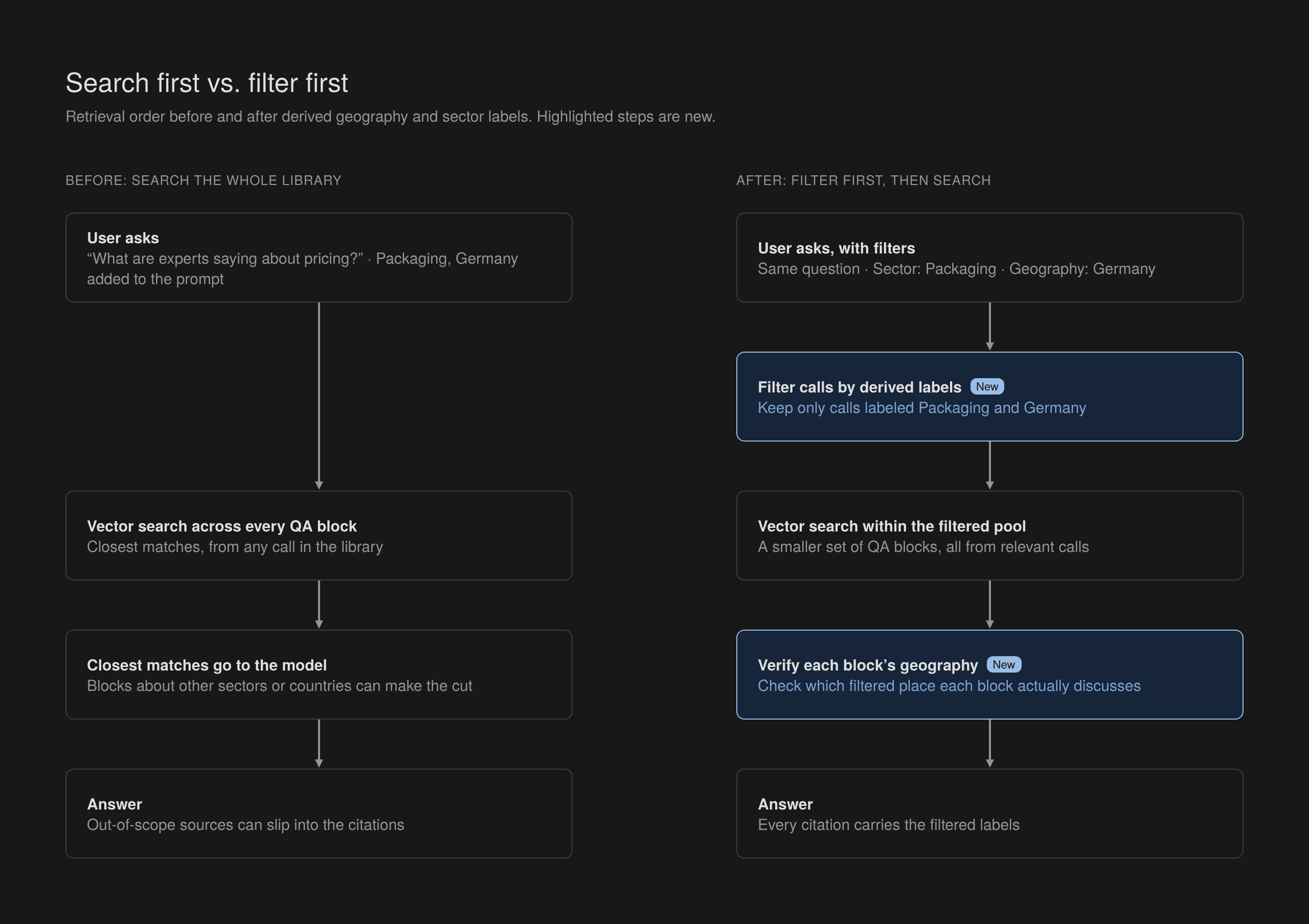
Alexandria retrieves information from QA blocks in our vector database by comparing an embedding of the search query with the embedded QA blocks and returning the closest matches. The more we can narrow that surface to blocks that we know are relevant, the better our retrieval is.
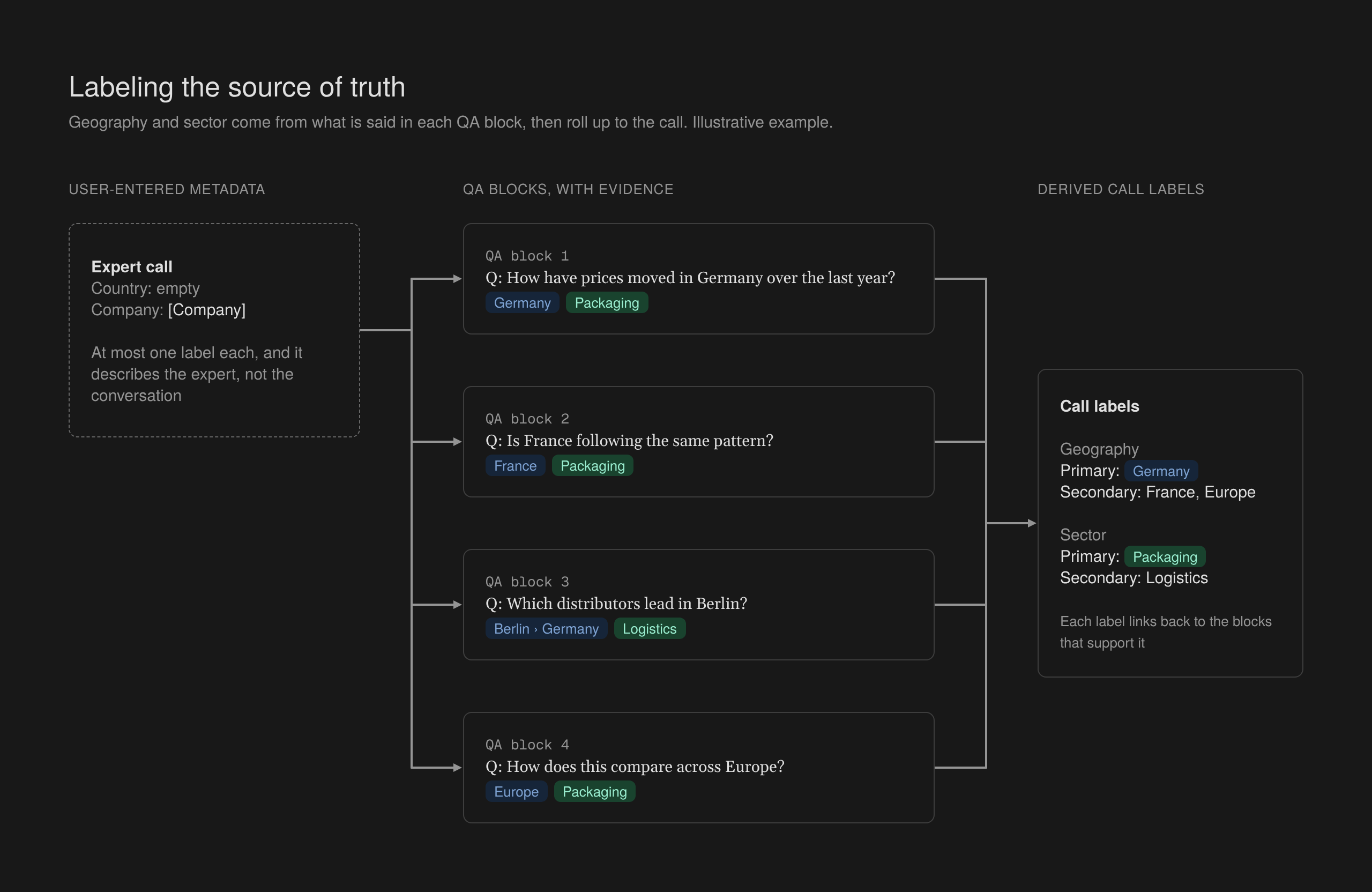
I built a classifier using an LLM that identifies the primary and secondary geographies and sectors of each call. Labels are assigned to each QA block as evidence. The classifier identifies a QA block as evidence if:
- It discusses a relevant geography or sector beyond just using it as an example
- The QA block is a continued conversation about a given geography or sector. For example, if the block doesn’t mention Germany, but is a direct follow-up question to a discussion about a German market, it also gets the label.
Those QA block labels are then all propagated up to the call level, so each call carries info on the discussion topics. If a label is the dominant discussion point of the call, it’s marked as primary. Otherwise, it is secondary.
Let’s compare classifier numbers to user entered numbers to see if we made the right call. Across expert network calls in Junior, we see the following:
| Label | User Input | Classifier Label |
|---|---|---|
| Geography | 44.6% (Country labels only) | 71.5% (identifies countries/regions/continents) |
| Sector | 80.6% (Company coverage - can’t always deduce sector) | 99.4% |
That’s great coverage. Let’s take a look at how it helps retrieval.
Filter first, then search
Now that every call is labeled, we can narrow the search before it starts. A narrower pool of calls to search means better retrieval at search time. This is where the benefit of this approach shines.
Here’s approach C against approach E on our test data. We used a test library and wrote 12 questions: four scoped by geography, four by sector, and four by both. Each question ran three times with the filter and three times with the scope written into the question instead (“Focusing on Germany, …”), for 72 answers in total.
We then checked every call each answer cited. A citation counted as in-scope only if the cited call carried a label matching every dimension the question asked for. A broader filter also matches its parts, so a call labeled Germany counts for Europe.
| Question type | Filter: in-scope share of citations (Approach E) | Text: in-scope share of citations (Approach C) |
|---|---|---|
| Geography only | 100% (160/160) | 87% (145/166) |
| Sector only | 100% (152/152) | 97% (188/193) |
| Geography + sector | 100% (159/159) | 63% (124/198) |
| All | 100% | 82% |
Without asking users to enter or backfill a single label, filtering keeps every citation in scope. That 100% holds by design: the filter only returns calls that carry the requested labels, so the real test is whether those labels are right.
To check, a max-effort Opus model with a separate prompt reread 48 randomly sampled calls and graded every label the classifier assigned: 97% were correct, including 96% of primary geographies and 98% of primary sectors. Searching on text alone, by contrast, strayed out of scope in 18% of citations overall, and in 37% when a question asked for both a geography and a sector.
The reason for this is that without filters, we have to search a larger area of QA blocks to find the information relevant to our question. But with filters, we can search on a smaller area of blocks from calls labeled with the filters, and formulate an answer based on the best datapoints from that group.
Tradeoffs
Labeling the library ourselves isn’t free, and it changes what a filtered search can see.
- Unlabeled calls drop out of filtered results. 28.5% of calls have no geography label, so a geography filter never surfaces them. That trades some recall for precision: a call we fail to label is missed, but an out-of-scope call can’t slip in. We had the same max-effort Opus judge read 39 randomly sampled calls with no geography label. 72% had no explicit geographic discussion. Most of the rest were US calls where the country was implied by minimal context, like a few references to Medicare or HIPAA, rather than larger discussion. Taken at face value, that means the classifier labels about 90% of the calls that actually discuss a place.
- Labeling has a cost. New calls are labeled automatically when they’re added to the library, and relabeled when their QA blocks are edited. A nightly job requeues any call whose label is missing, failed, or stale. Existing libraries are labeled once in a backfill. Labeling costs about 6 cents per call, so a library of 10,000 calls costs roughly $600 to label.
What else the labels unlock
Beyond the demonstrated benefits to chat retrieval, these labels are the basis for a number of new powerful pieces of Alexandria.
- The Library Explorer: This page allows you to view all the calls in your transcript library without having to chat first. We incorporate both geography and sector filters, helping you to quickly find those calls you had 6 months ago about data centers in Australia.
- The Mekko Chart: When starting a new Alexandria chat, we display the sector split of your firm’s library of calls to get a convenient overview of your coverage.
- More to come: We’ve got a number of new Alexandria features in the roadmap that will leverage this data. Stay tuned!
Looking Forward
As LLMs keep getting better at classifying legacy data, this method of retrieval improvement sets a valuable precedent. Creating effective, well built classifiers allows us to label data in a format optimized for our purposes without consuming user time or adding friction to the user experience.
When users don’t give you the data, build it yourself, at a level of detail user input never could.